
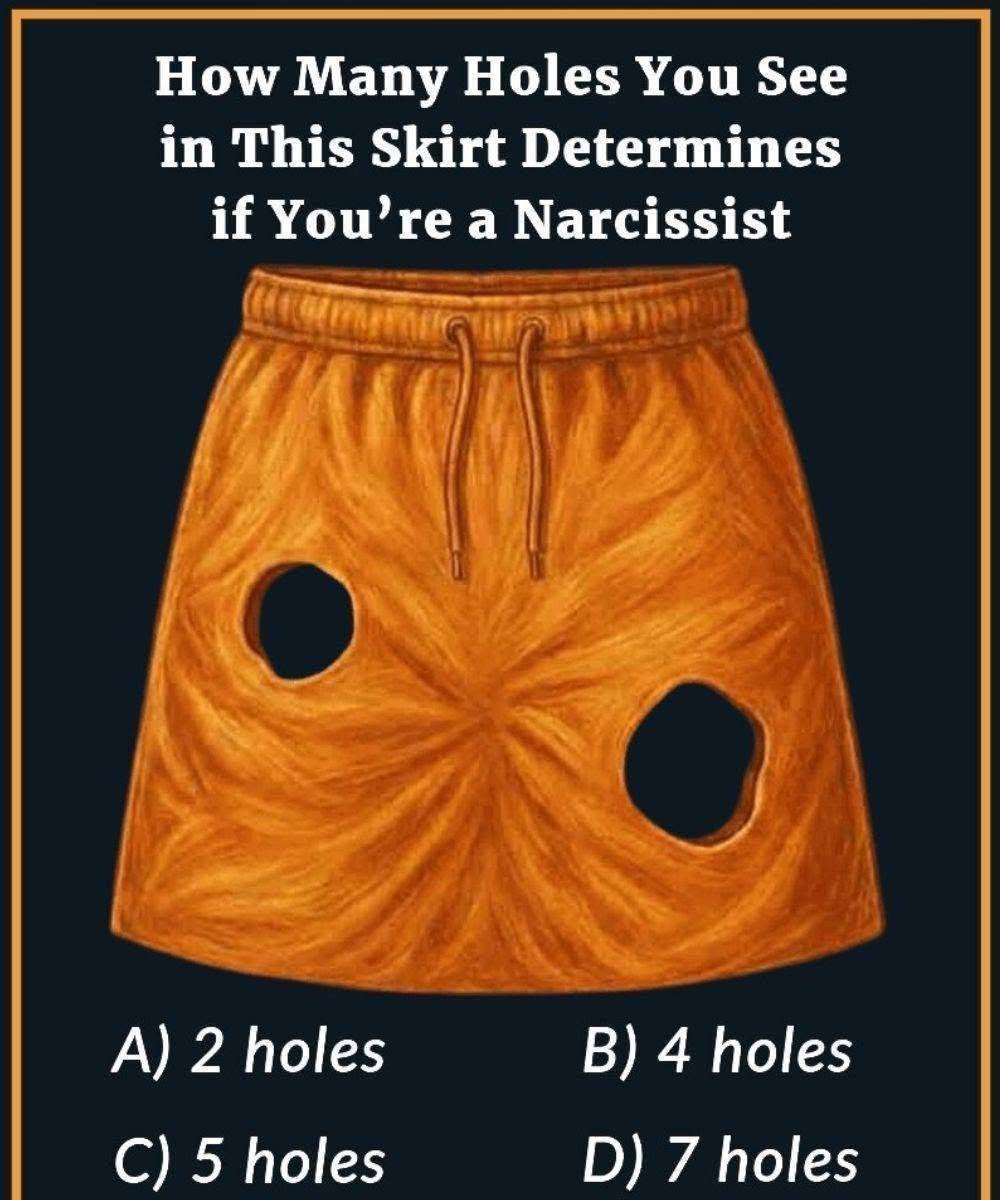
A strange visual puzzle has been making its way around social media with a provocative question:
“How many holes do you see in this skirt?”
The headline often goes one step further, claiming that the answer can reveal whether someone is a narcissist.
It is an irresistible combination for the internet: a simple picture, a question that appears to have an obvious answer, and a personality label that promises to explain something about the person looking at the image.
But there is a problem.
A person’s answer to a picture puzzle cannot reliably determine whether that person is a narcissist.
What the puzzle can reveal is something much more interesting: how differently people interpret visual information, how assumptions influence perception, and why two people can look at exactly the same image and confidently arrive at different answers.
So if you’ve encountered the skirt puzzle and wondered whether your answer says something deep about your personality, don’t worry. You haven’t accidentally received a psychological diagnosis from a social-media image.
Instead, the puzzle provides an entertaining opportunity to think about perception, ambiguity, reasoning, and the psychology of viral content.
The Viral Question
The basic challenge is deceptively simple.
A picture shows a skirt with several apparent openings or damaged sections. Viewers are asked to count the number of holes.
At first glance, the task sounds like ordinary counting.
But ambiguity quickly appears.
Does a visible opening count as one hole?
What if you can see through the fabric?
What if the opening continues through the front and back?
What if there are holes on both sides?
What if the fabric has been cut away completely?
What if you’re supposed to count only the obvious openings rather than every possible passage through the material?
Suddenly, the puzzle isn’t simply about arithmetic.
It’s about what you mean by a hole.
Why People Get Different Answers
Human perception isn’t a camera.
When we look at an image, our brains don’t merely record every pixel and present an objective description.
Instead, the brain interprets what it sees.
It uses context, expectations, previous experience, and assumptions to construct a meaningful representation.
That’s why ambiguous pictures can produce different interpretations.
One person may count only the obvious openings.
Another may reason that an opening passing through both sides of the garment represents more than one hole.
Someone else may interpret damage differently.
All three people can be looking carefully at the same picture.
The disagreement doesn’t necessarily mean one person is intelligent and another is not.
It may simply mean they are applying different definitions.
What Exactly Is a Hole?
This is the central problem.
Suppose you have a piece of fabric with a circular opening.
Most people would say it has one hole.
Now imagine that the opening goes through both the front and back of a garment.
Should that count as one opening?
Or two openings because there are two surfaces?
The answer depends on the definition you’re using.
This is why visual riddles involving holes can become surprisingly complicated.
The puzzle isn’t always testing your ability to count.
Sometimes it is testing whether you notice that the question itself is ambiguous.
The Narcissism Claim
The most attention-grabbing version of the puzzle claims that your answer reveals whether you’re narcissistic.
This sounds psychologically sophisticated.
It isn’t.
Narcissism is far more complicated than choosing one answer to an ambiguous image.
Clinical narcissistic personality disorder is a mental-health diagnosis that involves a persistent pattern of characteristics and behaviors. It cannot be established through a single personality quiz, optical illusion, social-media challenge, or visual puzzle.
Even the broader concept of narcissistic traits is multidimensional.
People can display varying degrees of self-focus, sensitivity to criticism, entitlement, admiration-seeking, or interpersonal difficulties without meeting criteria for a personality disorder.
A picture of a skirt cannot measure all of that.
Why These Headlines Go Viral
The headline is designed to create curiosity.
Compare these two headlines:
“How Many Holes Are in This Skirt?”
and:
“How Many Holes You See Determines if You’re a Narcissist.”
The second is much more emotionally charged.
It encourages people to immediately test themselves.
Nobody wants to miss a personality revelation about themselves.
Some readers may think:
“What if my answer means I’m narcissistic?”
Others may think:
“I’m definitely going to prove I’m not.”
Either way, the headline has succeeded in creating engagement.
The Psychology of Personality Tests
People are naturally fascinated by personality.
We want to know:
Am I introverted or extroverted?
Am I analytical?
Am I empathetic?
Am I a perfectionist?
Am I a narcissist?
Am I more creative than average?
What does my favorite color say about me?
Personality quizzes provide simple answers to complicated questions.
That simplicity is part of their appeal.
But meaningful psychological assessment is generally more complicated.
