
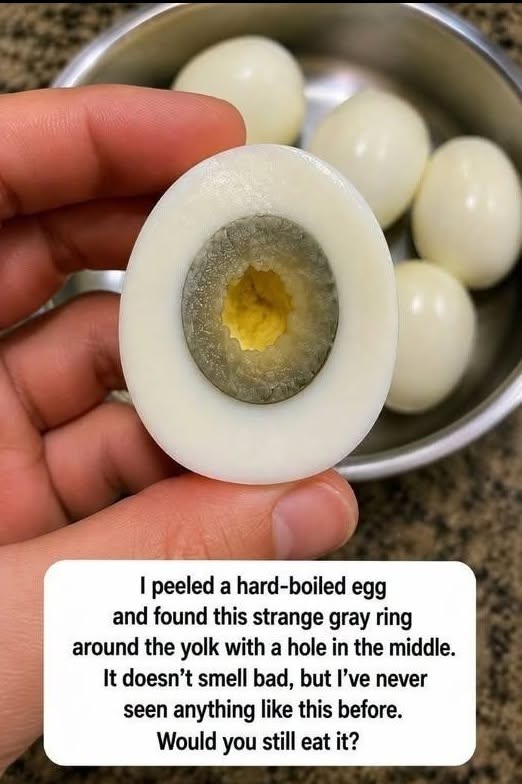
But there are still a few important food-safety rules to know.
What Causes the Green Ring?
Eggs naturally contain sulfur in the whites and iron in the yolks.
When an egg is cooked for too long or at too high a temperature, these compounds can react near the boundary between the white and yolk. This can create the familiar greenish-gray ring.
The University of Illinois Extension explains that the reaction becomes more noticeable when eggs are overcooked, cooked at excessive heat, or cooled too slowly.
So that strange color isn’t necessarily a sign that your egg has gone bad.
It’s often simply a sign that the egg was cooked longer or hotter than necessary.
Is a Green Ring Dangerous?
A green ring by itself isn’t generally considered a food-safety problem.
For Complete Cooking STEPS Please Head On Over To Next Page Or Open button (>) and don’t forget to SHARE with your Facebook friends
Illinois Extension notes that the sulfur-and-iron reaction responsible for the green color does not affect the flavor or wholesomeness of the egg.
The USDA’s hard-cooked egg quality guidance, however, treats green or gray discoloration as an undesirable quality characteristic. In other words, it isn’t the appearance you want from a properly prepared hard-cooked egg, even though the familiar green ring can result from overcooking.
That’s an important distinction:
Unattractive doesn’t automatically mean unsafe.
Why Does the Yolk Sometimes Look Gray?
The same basic cooking reaction can produce grayish coloring around the yolk.
If the egg is cooked aggressively, the outer portion of the yolk can develop a gray or green tint.
The longer the egg remains exposed to high heat, the more noticeable the reaction can become.
That’s why perfectly cooked hard-boiled eggs generally have a clean white exterior and a yellow yolk without a pronounced green ring.
What About a Hole in the Yolk?
A hole or unusual cavity is different from a simple green ring.
Egg yolks can sometimes have irregular shapes or textures after cooking, but an unusual cavity shouldn’t automatically be assumed to be caused by the same sulfur-and-iron reaction.
If an egg has unusual discoloration throughout the egg, an unpleasant odor, sliminess, mold, or other signs of deterioration, don’t rely on the green-ring explanation.
When food looks or smells genuinely spoiled, it’s safer to discard it.
How to Prevent the Green Ring
The easiest solution is to avoid overcooking the eggs.
USDA’s current instructions for hard-cooking eggs recommend placing eggs in a saucepan, covering them with water, bringing the water to a boil, then using controlled standing time depending on egg size. USDA also recommends cooling the eggs promptly afterward and refrigerating them within two hours.
For Complete Cooking STEPS Please Head On Over To Next Page Or Open button (>) and don’t forget to SHARE with your Facebook friends
For example, USDA lists approximately:
Medium eggs: 12 minutes
Large eggs: 15 minutes
Extra-large eggs: 18 minutes
After cooking, run cold water over the eggs and cool them promptly.
Illinois Extension gives another method: bring covered eggs to a boil, remove them from the heat, let them stand for about 11–13 minutes, then chill them in ice water.
