
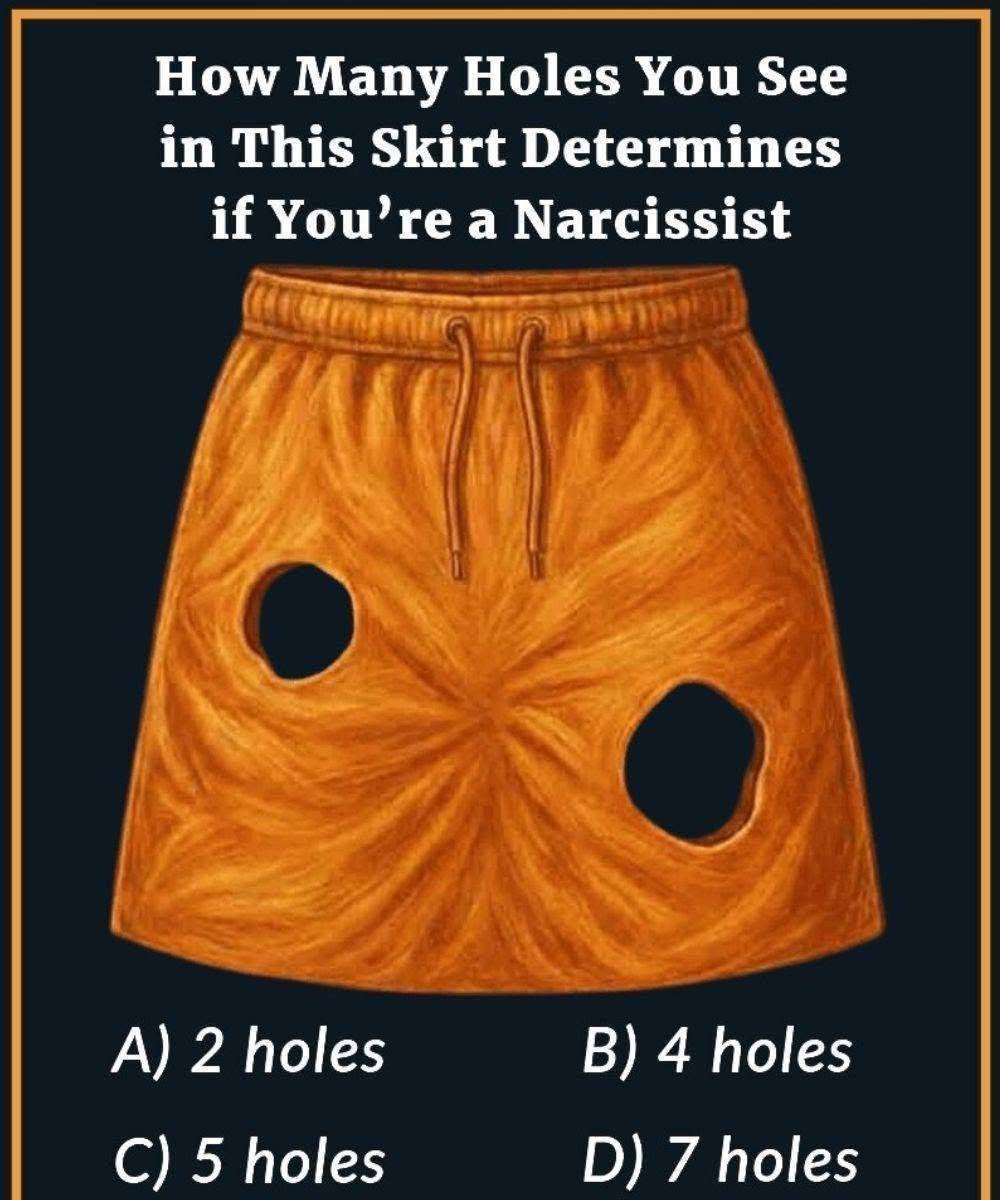
you might reasonably ask:
“What counts as a hole?”
That may sound pedantic.
But defining terms is essential in mathematics, science, law, philosophy, and everyday problem-solving.
Many arguments happen because people use the same word to mean different things.
The skirt puzzle is a playful example of this broader phenomenon.
Why Some People Count More
People who provide a higher number may be noticing additional details.
They may reason that a hole can exist on both the front and back of a garment.
They may count openings created by damage.
They may consider areas where fabric has been removed entirely.
They may also be interpreting the image as a physical object rather than a flat photograph.
This doesn’t make them more perceptive—or more narcissistic.
It simply reflects their chosen interpretation.
Why Some People Count Fewer
People who give a lower number may be using a simpler definition.
They may count only clearly visible openings.
They may treat an opening through multiple layers as a single hole.
They may ignore damage that doesn’t clearly create a separate passage.
Again, this doesn’t indicate a particular personality type.
It’s simply another reasonable way of interpreting an ambiguous visual problem.
Is There Actually a Correct Answer?
Sometimes viral puzzles have an intended answer.
The creator may have designed the image around a particular counting method.
But an intended answer isn’t necessarily the only logically defensible answer.
That distinction matters.
If the puzzle doesn’t clearly define what constitutes a hole, disagreement is inevitable.
A good puzzle should ideally provide enough information for the intended interpretation to be understood.
If it doesn’t, then the ambiguity becomes part of the challenge.
The Difference Between a Riddle and a Psychological Test
A riddle asks you to solve a problem.
A psychological assessment attempts to measure characteristics of a person.
These are fundamentally different activities.
A riddle might reveal how you approached one particular problem.
It doesn’t automatically reveal a stable personality trait.
Imagine someone makes a mistake on a crossword clue.
Would that prove they’re unintelligent?
Obviously not.
The same principle applies here.
One answer to one ambiguous visual question cannot establish narcissism.
What Does Narcissism Actually Mean?
The term “narcissist” is frequently used online.
It has also become a popular insult.
But psychological narcissism is more nuanced.
Narcissistic traits can involve an excessive need for admiration, a strong sense of entitlement, self-importance, sensitivity to criticism, or difficulties with empathy and relationships.
Everyone can occasionally behave in self-centered ways.
That doesn’t mean everyone who does so has narcissistic personality disorder.
Personality exists on a spectrum, and diagnosis requires a much broader assessment.
Why Self-Diagnosis From Social Media Can Be Misleading
Social-media psychology often compresses complicated concepts into catchy statements.
Examples include:
“If you do this, you’re a narcissist.”
“If you sleep this way, you’re intelligent.”
“If you choose this color, you have this personality.”
These claims are attractive because they’re easy to understand.
But human behavior is rarely that simple.
A person’s personality is shaped by many factors, including biology, development, environment, relationships, experiences, and circumstances.
No single visual preference can capture all of that.
The Danger of Overinterpreting Everyday Behavior
Labeling someone a narcissist based on a puzzle can also trivialize genuine mental-health concerns.
People who have experienced difficult relationships with someone displaying narcissistic traits may use the term to describe what they’ve experienced.
But a clinical diagnosis should not be casually assigned to strangers, family members, coworkers, or celebrities based on isolated behavior.
Understanding psychology requires context.
What the Puzzle Can Teach Us About Critical Thinking
Although the narcissism claim is misleading, the puzzle can still teach useful lessons.
First: Question the premise.
If someone says:
“Your answer proves you’re narcissistic,”
ask:
“What evidence supports that?”
Second: Define the terms.
What exactly counts as a hole?
Third: Consider alternative interpretations.
Could another person reasonably see the image differently?
Fourth: Separate entertainment from evidence.
A viral challenge can be fun without being scientifically valid.
Fifth: Don’t confuse confidence with certainty.
Being confident doesn’t automatically make an interpretation correct.
Why Ambiguous Images Are So Effective Online
Ambiguous images create discussion.
People naturally want to compare answers.
Someone posts:
“I see six.”
Another person responds:
“How can you see six? There are obviously four!”
A third person adds another interpretation.
Suddenly, hundreds of comments appear.
The disagreement itself becomes entertainment.
From a social-media perspective, this is highly effective.
The more people debate, the more attention the post receives.
The Emotional Hook
